

Last Updated on May 3, 2026 by Allied Dispatch UK | Published: May 3, 2026
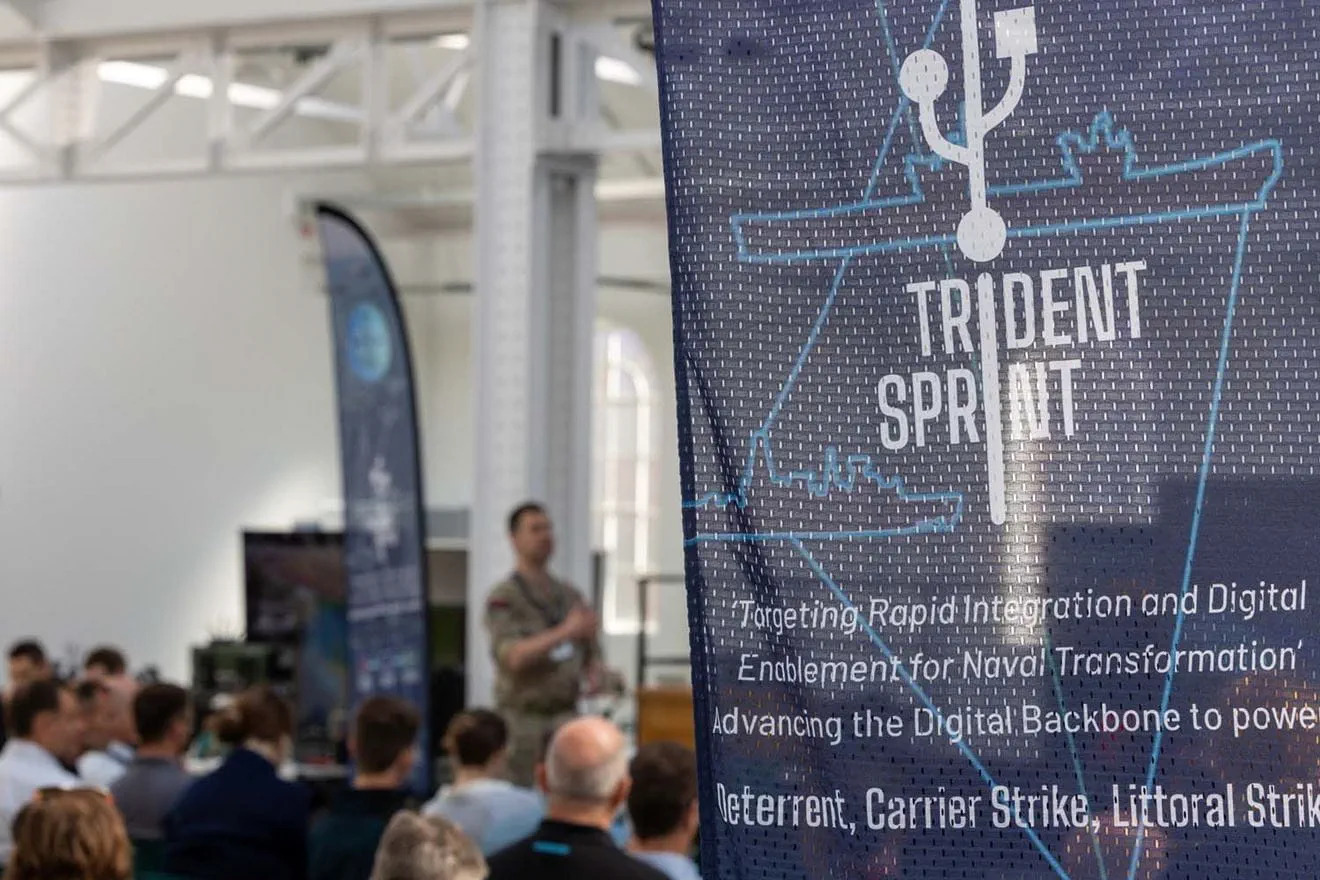
The Royal Navy has successfully concluded Trident Sprint, a high-intensity two-week trial designed to integrate uncrewed systems into a resilient, “mesh” digital network. The exercise marks a significant step toward the “Hybrid Navy,” where crewed ships and autonomous robots operate as a single, lethal entity.
Led by Navy Digital—the service’s specialists in digital capabilities and Information Warfare—the exercise brought together operators and over a dozen industry partners to test technology that allows data to flow even when traditional satellite links (SATCOM) or a single hub are denied.
Building the ‘Mesh’
The core of the exercise was creating a mesh network. Unlike traditional systems that rely on a single central hub, a mesh network allows every ship, drone, and boat to communicate directly with one another.
- Resilience: If one part of the network is jammed or destroyed, the data simply finds another path through the network.
- Decision Edge: Real-time intelligence from the frontline was fed back to a command node ashore, allowing commanders to evaluate threats and launch responses faster than an adversary can react.
Hardware in the Solent
The exercise featured a mix of established platforms and cutting-edge prototypes:
- Kraken & Beehive: The Royal Navy utilised Kraken uncrewed vessels and drones to carry out simulated missions ranging from reconnaissance to payload delivery.
- Beehive Integration: A major success of Trident Sprint 2 was the formal integration of “Beehive” craft into the wider digital fighting network, with the Navy declaring them as integrated components of the Joint Force.
- P2000 Patrol Boats: HMS Archer and other vessels from the Coastal Forces Squadron were used as testbeds to see how crewed ships can manage the massive volumes of data generated by uncrewed swarms.
A New Way of Procurement
Vice Admiral Steve Moorhouse, Fleet Commander, emphasised that Trident Sprint isn’t just about the “kit”—it’s about the speed of innovation. By working directly with industry experts in cloud computing and cybersecurity, the Navy is aiming to produce results faster than traditional, often slow, procurement timelines.
“We are learning faster, finding problems earlier, and turning new technology into practical warfighting advantage,” said Vice Admiral Moorhouse. “Embracing this style of rapid experimentation is essential in bringing to life the hybrid navy.”
Allied Dispatch Viewpoint
Trident Sprint confirms that the Royal Navy is focusing heavily on the “connective tissue” of the fleet. The ability to operate uncrewed boats and drones is one thing; the ability to keep them talking to each other in a contested electronic environment is what will determine success in a future conflict.
By declaring these autonomous craft as “integrated components,” the Navy is showing that these are no longer just experiments; they are now part of the order of battle.