

Last Updated on April 25, 2026 by Allied Dispatch UK | Published: April 25, 2026
For hundreds of years, horses and soldiers were inseparable, but the rise of tanks and helicopters appeared to end that era. Today, the British Army is quietly rediscovering the value of the “War Horse,” not just for ceremony, but as a serious tactical tool inspired by the dense forests of the Baltics.
The shift has been prompted, in part, by an unexpected development in Estonia that has caught the attention of British military planners.
The Estonian War Horse Inspiration
Within the Estonian Defence League, a small group of volunteers has formed a mounted unit to tackle terrain where even the most advanced modern vehicles struggle.
- The Challenge: In a country where more than half the land is forested and much of it is boggy, heavy platforms like the CV90 can find themselves stuck or restricted to predictable roads.
- The Solution: The Estonian unit reported that horses could move effectively and silently through dense woodland and marshland where engines fail.
Navigation at Barossa: The Princess Elizabeth Cup
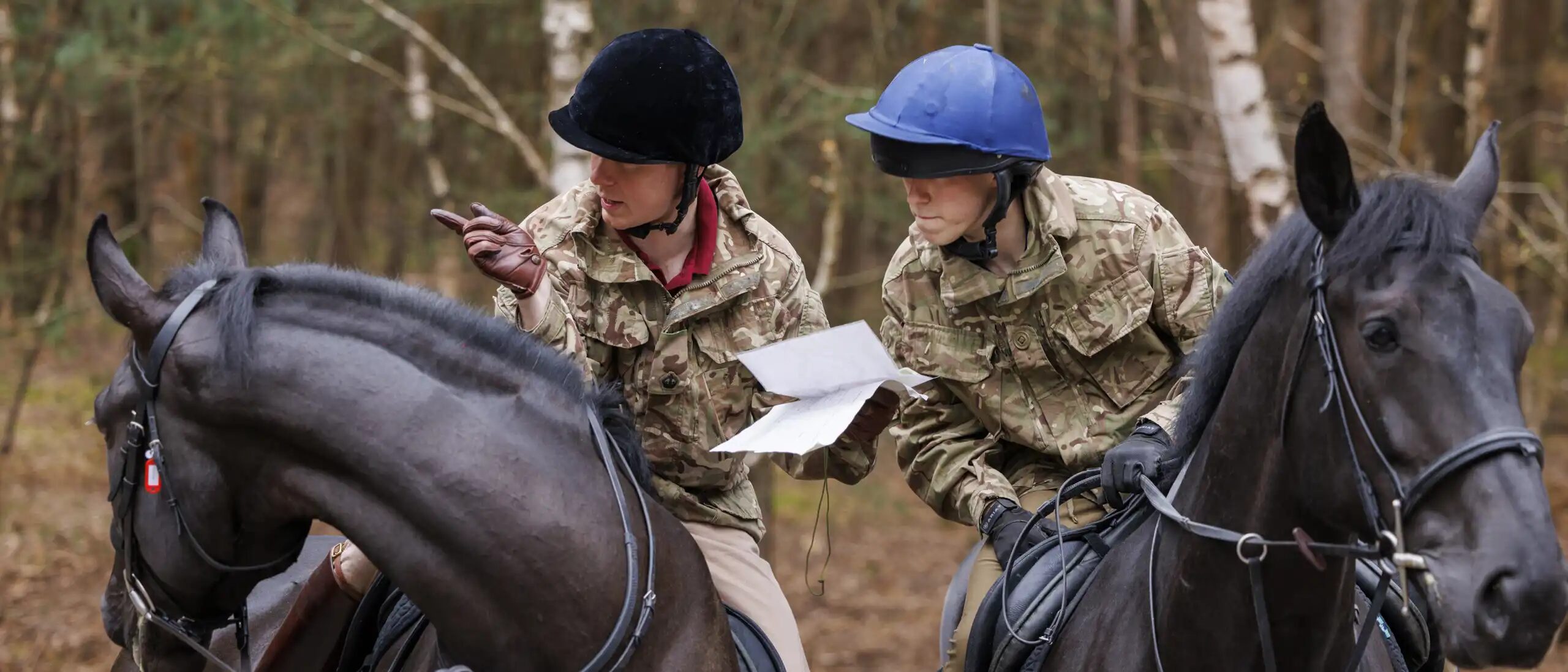
Taking these lessons from Estonia, the Household Cavalry Mounted Regiment (HCMR)—best known for its ceremonial role at the King’s Birthday Parade—has introduced a major tactical update to the Princess Elizabeth Cup.
This competition has run for 77 years, but this year saw a brand-new addition: a mounted navigation exercise at the Barossa Training Area.
- Back to Basics: Soldiers were tasked with crossing the challenging, muddy terrain of Barossa, relying solely on a map and compass. No GPS and no digital assistance.
- Total Concentration: As one soldier described it, navigating through thick gorse and deep mud while controlling a powerful animal is a “completely different experience.” It requires exercising every part of the brain at once to maintain calm in the “chaos” of the ride.
“Doing the Basics Well”
For Commanding Officer Lieutenant Colonel Ben McNeil, the purpose of this return to horseback navigation is clear: “The only way we can be better as soldiers is to do the basics well.” While the Army isn’t abandoning its armoured vehicles, the exercise proves that if you can navigate while riding an unpredictable animal, you develop a level of mental fortitude and focus that makes you a “formidable force” in any military context.
Allied Dispatch Viewpoint: The Value of Low-Signature Stealth
At Allied Dispatch, we believe learning from the Estonians to revive “low-tech” skills like horseback navigation is a brilliant move.
In a modern “near-peer” conflict where GPS might be jammed, and thermal sensors pick up every engine block, a horse provides a silent, low-signature alternative that can go anywhere. We support this because it focuses on the “Human Dimension” of warfare. Taking the Household Cavalry out of the ceremonial spotlight and into the mud of Barossa proves that the British Army is keeping its tactical edge sharp in the most practical ways possible.
What do you think?
- The Estonian Model: Should more UK units look at horses for “niche” roles in forested or boggy environments?
- Basics vs. Tech: Is the focus on map-and-compass navigation still relevant in an era of satellite technology?
- Versatility: Does the ability to lead an animal make for a better leader of people?
The “War Horse” is proving its worth once again at Barossa. We’ll be watching to see if this Estonian-inspired navigation training becomes a permanent fixture across the Cavalry.