

Last Updated on June 13, 2026 by Allied Dispatch UK | Published: June 13, 2026
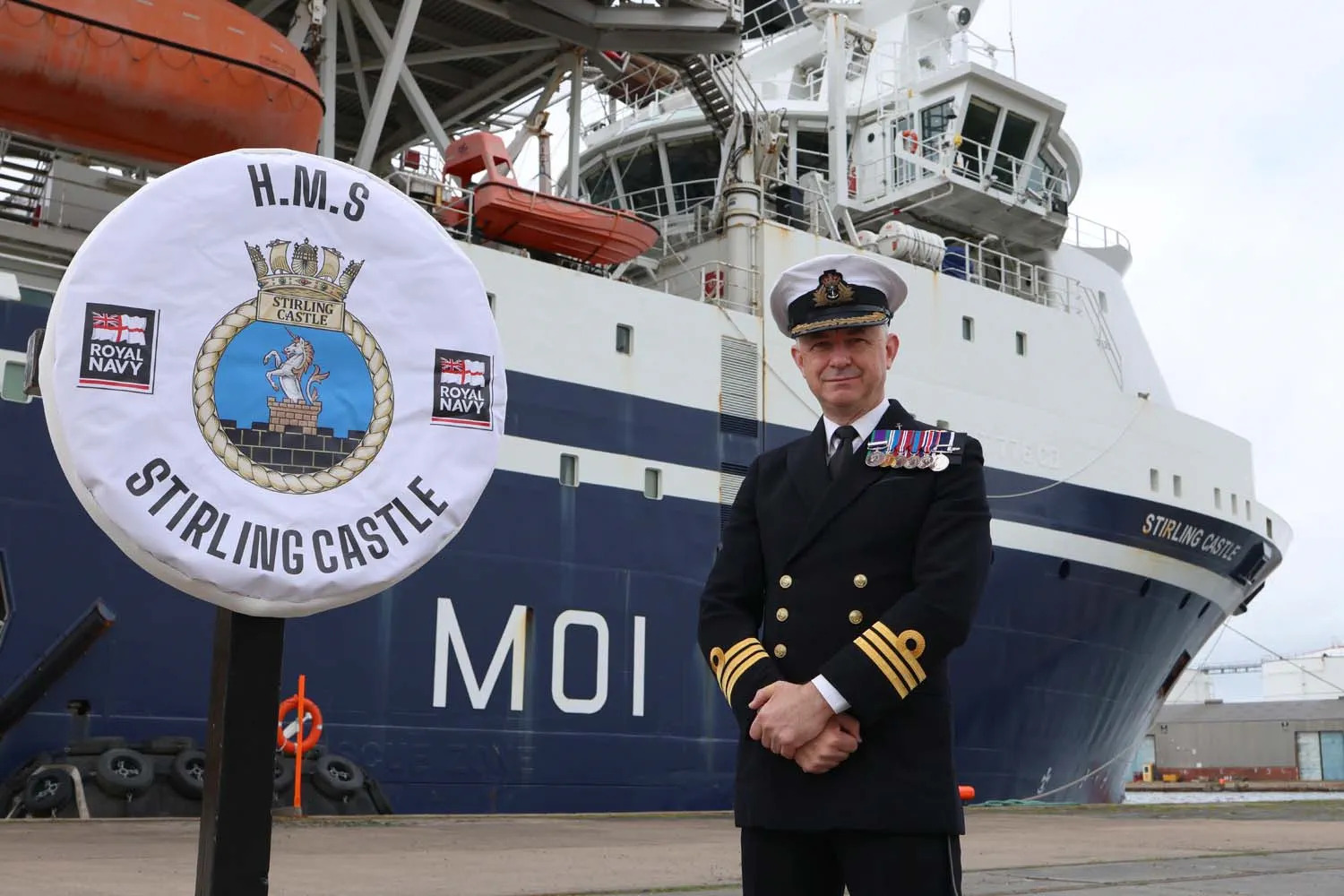
In a historic ceremony on the banks of the Firth of Forth, Britain’s unique minehunting mothership, HMS Stirling Castle, has been officially welcomed into the Royal Navy fleet.
The vessel sailed as close as physically possible to her affiliated city of Stirling, berthing at the Port of Grangemouth, to mark the formal beginning of her operational life under the White Ensign. The ceremony brought together the ship’s 45-strong company of sailors and officers, their families, senior naval officers, and civic leaders, all serenaded by the Royal Marines Band.
From Auxiliary Support to Frontline Warship
The commissioning marks the culmination of a significant structural transition for the vessel:
- 2023 Acquisition: The ship was originally purchased from the commercial sector in 2023 to serve within the Royal Fleet Auxiliary (RFA) as a trial platform for autonomous systems.
- July 2025 Redesignation: Following extensive evaluation, she officially shifted from the RFA to become a commissioned Royal Navy warship, hoisting the White Ensign alongside in Birkenhead.
- June 2026 Fleet Integration: This week’s formal commissioning marks her official entry into the active Surface Fleet registry, based out of HMNB Portsmouth.
To mark the continuity of generations within the Naval Service, the traditional cutting of the commissioning cake was shared between the Commanding Officer’s wife, Helen Harper, and the youngest sailor on board, Able Seaman Brinley Pollard.
The Logic of the Mothership: Deploying Autonomy at Range
HMS Stirling Castle represents a fundamental tactical departure from how the Royal Navy has historically handled mine countermeasures (MCM). Rather than sending traditional, crewed glass-reinforced plastic hull minehunters—such as the legacy Hunt and Sandown classes—directly into dangerous, live minefields, the Navy is pivoting to a digital, standalone “mothership” concept.
Stirling Castle acts as a mobile launch, recovery, and command hub for a formidable array of remotely operated and autonomous underwater vehicles (UUVs) and crewless surface vessels (USVs). These robotic systems scour the seabed to locate, identify, and destroy naval mines, keeping the human crew at a safe distance.
The ship’s sponsor, Baroness Davidson of Lundin Links, emphasised this exact capability shift during her address:
“Without ships like Stirling Castle to deliver the embarked teams and equipment to the minefield, there is no way to deploy autonomy and uncrewed systems at range. With this ship informing the operation of future Royal Navy mine countermeasures support vessels… the future of mine countermeasures is bright.”
Commanding Officer Commander Phil Harper echoed the human element behind the technology, stating:
“A ship commissioning is like a christening, and like the best christening events, we are surrounded by the friends and family that give meaning to our service.”
Allied Dispatch Viewpoint
The formal commissioning of HMS Stirling Castle could not have come at a more critical juncture for the Royal Navy. With RFA Lyme Bay currently in Cyprus staging for a high-intensity mine clearance operation in the Strait of Hormuz alongside HMS Dragon, the absolute necessity of the “mothership” doctrine is being tested in real-time.
As the Ministry of Defence grapples with the ongoing fallout from the high-profile political resignations of John Healey and Al Carns over the upcoming Defence Investment Plan (DIP), Stirling Castle is a tangible example of the exact “automation and uncrewed pull-through” that departing ministers argued must be properly funded.
By taking a commercial hull and transforming it into an advanced drone carrier, the Navy has proven it can field cutting-edge, safer, and highly effective defensive capabilities on a leaner footprint. However, if the incoming Defence Secretary Dan Jarvis is to successfully navigate the current budget crisis, ensuring that platforms like Stirling Castle have the long-term funding, software support, and spare parts pipelines to remain operational in home waters will be vital to safeguarding the UK’s sovereign maritime trade routes.
What are your thoughts on the formal commissioning of HMS Stirling Castle? Is the transition away from traditional crewed minehunters to uncrewed ‘mothership’ operations the right move for the Surface Fleet amidst tightening hardware budgets? Let us know your thoughts in the comments below.