

Last Updated on June 13, 2026 by Allied Dispatch UK | Published: June 13, 2026
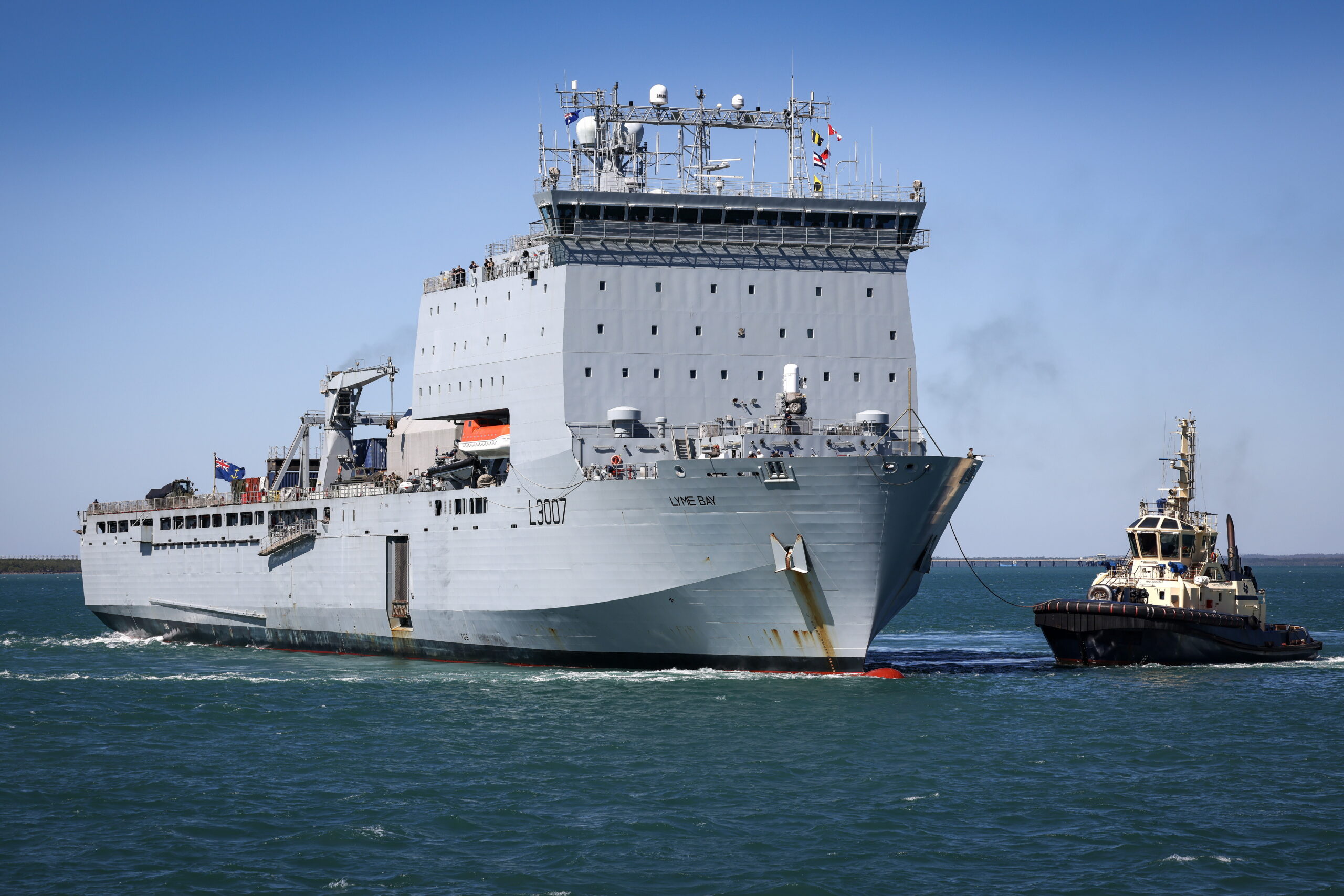
The support ship RFA Lyme Bay has arrived in Limassol, Cyprus, following a relentless and unforgiving Fleet Operational Sea Training (FOST) package in the Mediterranean, pushing both the core crew and embarked specialists to their absolute operational limits.
While the vessel’s recent modifications in Gibraltar to act as a mine countermeasures mothership have grabbed headlines, the real story of her transit to the Eastern Mediterranean has been the intense, around-the-clock training delivered by specialists from Plymouth. With the ship preparing for a high-stakes, forward-deployed mission to safeguard freedom of navigation in the volatile Strait of Hormuz, the FOST organisation ensured that every individual on board is fully prepared to operate in harm’s way.
Relentless Scenarios: Testing the Crew to Failure
Operating in one of the most heavily contested and volatile maritime choke points on Earth leaves zero margin for error. To guarantee the ship’s survivability, the Plymouth-based FOST mentoring and assessment team subjected the 60-strong Royal Fleet Auxiliary ship’s company and more than 100 embarked mine warfare and diving personnel to realistic, escalating disaster scenarios.
The training focused heavily on keeping the ship fighting through worst-case conditions, forcing the crew to respond to complex, simultaneous emergencies:
- Mass Casualty & Battle Damage: Drill scenarios simulated heavy weapon impacts, forcing damage control teams to contain flash fires and rushing water in claustrophobic, smoke-filled compartments while simultaneously treating complex, mock blast casualties under emergency lighting.
- Total System Failures: Engineers were pushed to the brink by sudden, unannounced power blackouts and critical steering gear breakdowns, testing the crew’s ability to navigate and stabilise the massive Bay-class hull under pressure manually.
- Action Messing: The operational tempo didn’t stop for standard routines. Even the galley teams were integrated into the combat posture, practising “action messing” to sustain a crew operating on a constant war footing.
The relentless nature of the package was designed to build automatic, instinctive teamwork across the ship’s split civilian and military departments.
“Testing and Realistic”
The intense progression of the training program drew high praise from both the ship’s senior leadership and the FOST personnel observing the evolution.
Reflecting on the grit shown by the crew as the scenarios grew in complexity, Lyme Bay’s second-in-command, Executive Officer Chief Officer Steven McCubbin RFA, stated:
“It’s testing, it’s realistic, but I am really pleased at how everyone has pulled together.”
First Officer Paul Creek RFA, one of the dedicated assessors from the Navy’s FOST organisation delivering the package, echoed the sentiment, noting the steep learning curve the crew successfully climbed:
“It has been nice to see how the ship’s company have really engaged and executed effective training which has resulted in strong progression.”
Next Steps on the Horizon
Having successfully passed the rigorous FOST hurdles, RFA Lyme Bay is utilising her time alongside in Limassol to conduct a scheduled crew rotation, take on fresh stores, and embark additional personnel from the Mine Threat Exploitation Group (MTXG) and the Fleet Diving Group.
Once replenished, she is expected to transit the Suez Canal to link up with the Type 45 destroyer HMS Dragon, which is already operating east of Suez. Together, HMS Dragon’s high-end air-defence umbrella and Lyme Bay’s freshly drilled crew will form the core of the UK’s defensive contribution to securing vital international shipping lanes.
Allied Dispatch Viewpoint
Amid the ongoing political debate over defence funding and hardware procurement back in Whitehall, the successful completion of RFA Lyme Bay’s FOST package is a timely reminder of where a navy’s true capability lies: its people. You can modify hulls and pack a deck with cutting-edge autonomous technology, but those systems are completely useless if the crew cannot keep the ship afloat, powered, and fighting through a major incident.
FOST remains the gold standard for operational readiness because it intentionally breaks things and forces human ingenuity to fix them. As Lyme Bay prepares to enter one of the most volatile operating areas in the world, the rigorous testing she endured in the Mediterranean ensures that if the worst should happen in the skies or waters of the Gulf, her crew has already faced it—and beaten it—in training.
What are your thoughts on the intensity of the Royal Navy’s FOST training pipeline? In an era increasingly dominated by autonomous tech, how critical is it that we keep focusing heavily on traditional, high-intensity damage control and human endurance? Let us know what you think in the comments below.